Water-Damaged Particleboard
By Discolapy, 02/01/2020
Particleboard is a building material that serves as an alternative to solid wood. It is made from compressed wood particles bonded with resin. It is less expensive than solid wood and is typically used in applications where high strength is not required.
In addition to being weaker than solid wood, particleboard is extremely vulnerable to water damage. Even brief or localized exposure to water—such as when a washing machine overflows onto a cabinet—can cause significant damage. Water can “travel” inside the board through capillary action, quickly compromising the material. The particleboard may swell and eventually crumble.
Direct contact with liquid water is not required for damage to occur. High humidity and water vapor—such as that produced by a kettle or dishwasher—can also degrade particleboard over time.
The extent of damage depends on both the composition of the particleboard and the nature of the water exposure.
Factors Affecting Water Damage
Composition of the particleboard:
Type of binding material and wood particles
Structure (homogeneous vs. graded density), manufacturing method, age, and overall density
Type of surface treatment and its water resistance (e.g. none, veneer, laminate, paint, paper)
Exposure conditions:
Direct contact with water vs. exposure to humidity or steam
Duration of water exposure
Additional mechanical stress (e.g. heavy objects on a particleboard table)
Repeated wet/dry cycles
Conditions after exposure (e.g. air drying, heating, or pressing)
The most critical factors are the type of particleboard and the duration of water exposure.
Types of Damage
Discoloration
Surface layer damage or removal (paint, veneer, laminate, etc.)
Swelling
Bending or warping
Structural disintegration
Mold growth
Experiment: Water Exposure and Drying
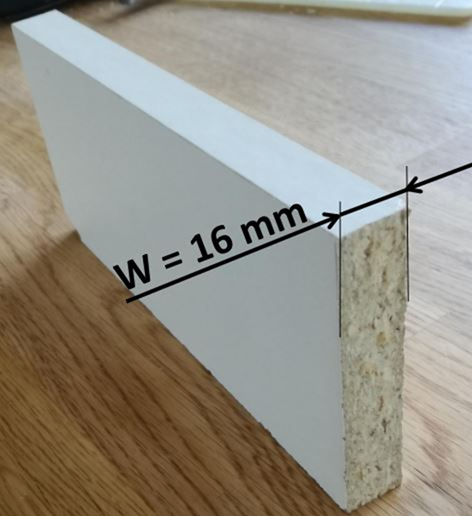
To demonstrate water damage in particleboard and the dynamics of this process, we conducted a simple experiment. A standard 16 mm thick particleboard with a white veneer on both sides was used. The thickness of the board (denoted as W) is shown in the image below.
Please note where the measurement is taken—near the edge of the board.
I dipped the particleboard into a water bath (approximately 2 mm deep). A 3D-printed support was used to keep the board in the desired position (see below).
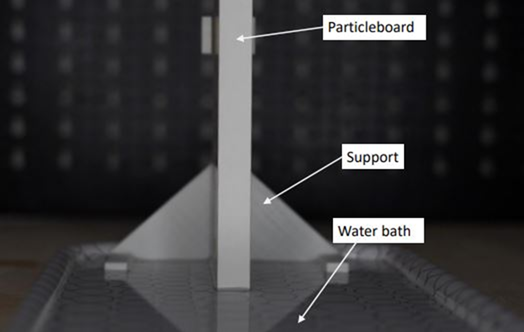
The particleboard was left in the water bath for 24 hours. A camera was used to observe the swelling process. After 24 hours, the water was removed from the bath, and the particleboard was left to dry under ambient conditions (~21 °C) for another 14 days.
The thickness of the board was measured both while it was partially submerged and at 12-hour intervals after it was removed from the water and allowed to dry. Based on these measurements, the amount of swelling was plotted as the increase in board thickness over time.
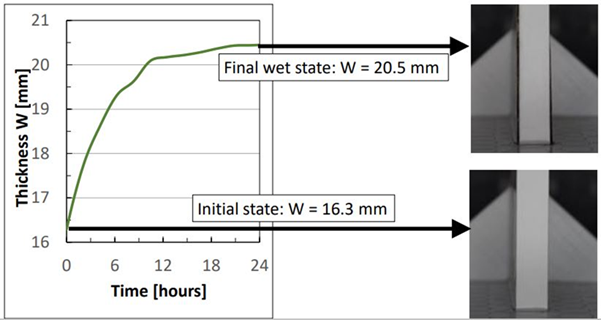
During the first hours of the “wet phase,” when the board was partially submerged, the thickness increased very rapidly. Note that the initially measured thickness of the “virgin” dry board was 16.3 mm, not exactly 16 mm as nominally specified.
The first three hours of water exposure are critical. If the board is removed from the water within this period, its thickness returns almost to its original value. After approximately six hours, however, the damage becomes permanent. After about 24 hours, the thickness of the particleboard reached its maximum value. Even if the board remains submerged for a longer time, the thickness (W) does not increase further, indicating that the swelling process has a natural limit.
The maximum measured thickness was approximately 20.5 mm.
The following graph shows how the board thickness changes as it dries. Note that the drying phase lasts much longer; therefore, the time scale is shown in days rather than hours. The wet phase is also included in the graph (green curve).
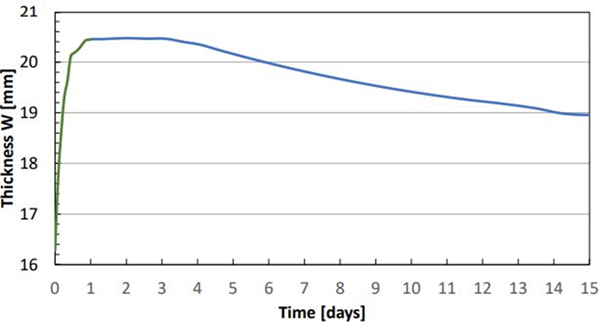
During the first ~2 days of the drying phase, there was no significant change in the particleboard thickness. The thickness then slowly decreased as water was removed from the material (mainly by diffusion). After about 14 days of drying, no further changes in thickness were observed. The new “dry” thickness was approximately 19 mm.
The particleboard was now permanently damaged.
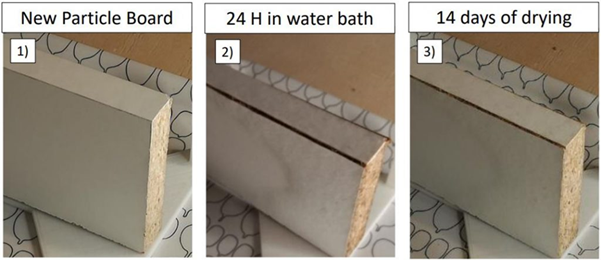
The images below show the board at three stages of the experiment:
New particleboard – before exposure to water
The board after 24 hours in the water bath (note the color change near the wet–dry boundary)
The board after 14 days of drying (the thickness near the edge is 19 mm)
Although the board is permanently damaged, it remains hard and reasonably functional from a mechanical point of view.
Conclusions:
- It is crucially important to remove water as soon as possible. After ~ 3 hours degradation is permanent. To that end it is very helpful to protect places through which water can penetrate the material with water resistant protection (paint). This slows down the process of sucking the water into the material.
- The process of drying is relatively long! In our case it took about two weeks until the thickness of the particle board reached its new “dry” thickness.
Note: The chronology of particleboard drying dynamics has been employed in the context of home insurance coverage assessments, especially in case of water loss damages [2]. As has been demonstrated here, the time when the loss occurred can be inferred by the thickness of the drying particleboard, assuming the original thickness can be established.
Related Literature:
[1] A. Wagenfuehr, S. Tobisch, R. Emmler, B. Buchelt, T. Schulz; Vener in Interioe World; IFN; 2012
[2] B. Davis, R. E. Moon; Thickness Swell in Particle Board: A forensic Tool for the Duration of Loss; Forensic Engineering 2015
Thanks for reading the article. In case you find it useful or have some comments, questions or suggestions, please let me know (see below for comment section).